
Closing Concert of Tony Carnevale’s Laboratory at the Frosinone Conservatory.
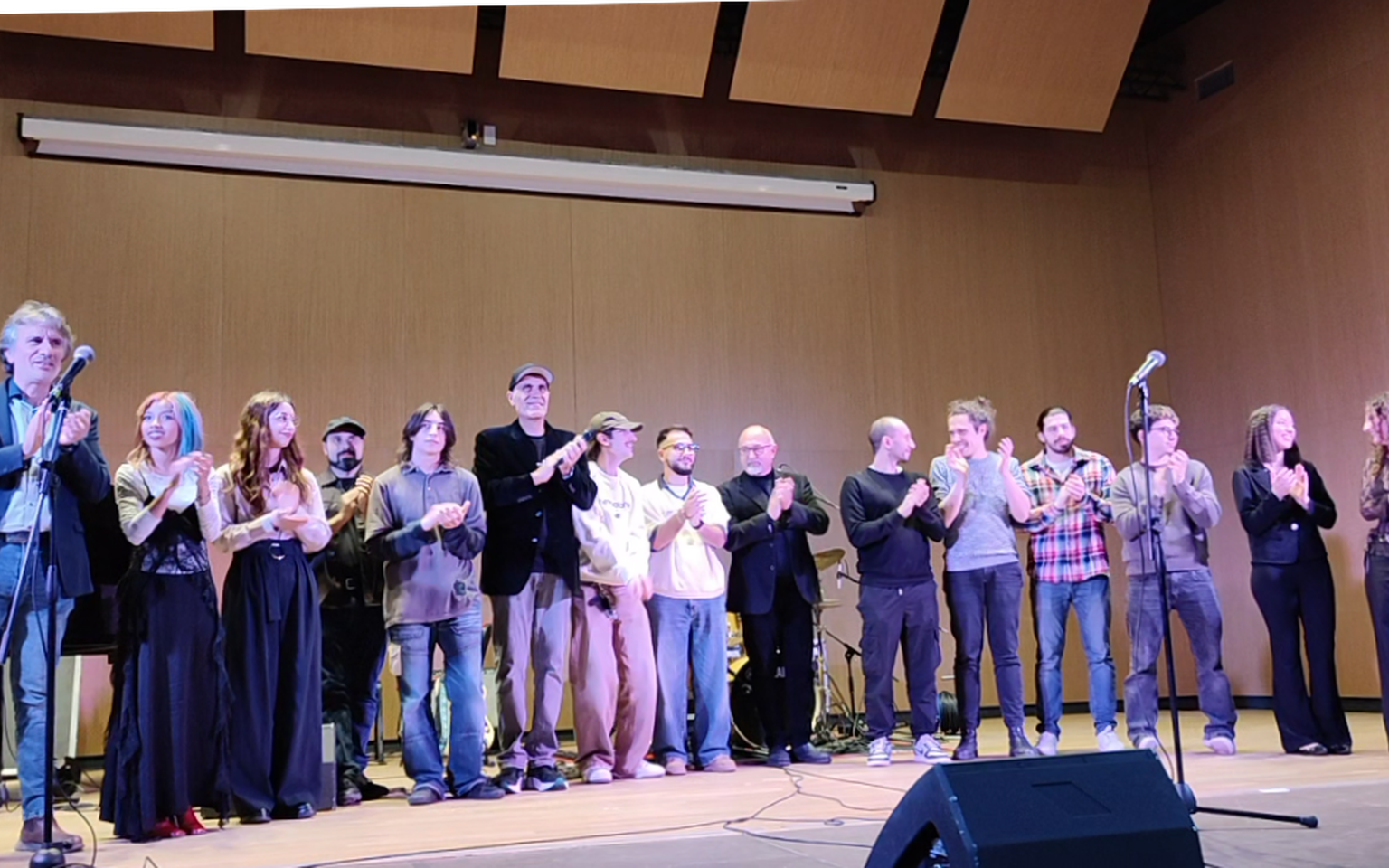
On November 14, 2026, the Live Presentation of original compositions developed during the “Artistic Direction of Music Production” Laboratory brought together creativity, music production, and the ANORA Method.
“Learning is experience; everything else is information.”
This is the phrase, attributed to Albert Einstein, that Tony Carnevale chose to convey the significance of the formative experience that concluded on November 14, 2026, at the “Licinio Refice” Conservatory of Music in Frosinone, Italy.
The Live Presentation marked the conclusion of the “Artistic Direction of Music Production” Laboratory, directed by Tony himself. The project involved 32 people in various capacities, from different courses at the Conservatory as well as from outside the institution, bringing them together in a collective undertaking encompassing formation, artistic creation, and music production.
Throughout the Laboratory, numerous original compositions were developed, addressing different aspects of the artistic and production process: composition, lyric writing, arrangement, performance, pre-production, recording, mixing, mastering, and artistic direction.
The compositions were initially at different stages of development, requiring specific interventions in creative development and musical realization. A significant part of the work took place at the Conservatory’s C.R.E.A. recording studio, involving musicians, performers, and technical personnel in the various stages of production.
The aim was not simply to produce finished musical works, but to enable participants to experience the concrete dynamics of a collective artistic project through the interaction of different skills, sensibilities, and responsibilities.
The Laboratory also incorporated Role Play, assigning specific roles and responsibilities within individual productions. Lyricists, composers, arrangers, performers, sound engineers, and artistic production coordinators worked together, addressing the creative, organizational, and relational demands of the project.
Particular attention was also devoted to the professional role of the Recording Director (Direttore della Fissazione), to the direction of performers during recording sessions, and to the relationships among the different professionals involved in music production.
Tony Carnevale retained overall artistic direction, overseeing the creative, organizational, and formative process while simultaneously entrusting participants with concrete responsibilities and a degree of autonomy.
Central aspects of the experience included the ability to understand and interpret artistic directions, face difficulties, identify solutions, collaborate, and take responsibility toward others.
From this perspective, reliability and mutual trust also become fundamental elements of professional development.
The ANORA Method: Beyond the Musical Outcome
The Laboratory was developed through the ANORA Method – Approccio NOn RAzionale (Non-Rational Approach), conceived and developed by Tony Carnevale as part of his research into the Psychodynamics of Creative Processes and the Formative Relationship. The method places particular emphasis not only on artistic outcomes, but also on the human processes through which those outcomes are achieved.
Musical activity thus becomes a concrete setting for exploring how people develop ideas, respond to difficulties, establish relationships, interpret experiences, and develop creative autonomy.
As Tony Carnevale emphasizes in his account:
“…the deeper meaning of this work goes beyond the productions themselves.”
Indeed, the quality of a musical composition does not, in itself, reveal the human and creative journey that gave rise to it, nor does it establish what transformations in thinking may have occurred among those involved during the experience. This is one of the fundamental distinctions underlying the research behind the ANORA Method: the artistic value of a finished work does not necessarily coincide with the formative value of the process that made it possible.
During the Laboratory, Carnevale observed participants confronting artistic, technical, and organizational challenges, experimenting with different roles (Role Play), discovering new expressive possibilities, and developing ways of collaborating.
The experience was also designed to encourage professional growth and the development of an original artistic identity, through greater awareness of each participant’s creative potential and through creative and project-based relationships with others.
The Live Presentation on November 14
The experience concluded with a public presentation at the Conservatory, featuring original compositions created and produced by the participants, including, as a distinctive aspect of the work undertaken, two different versions of the same composition.
The evening involved 16 participants in the artistic and technical activities of the presentation. The performances alternated between live musical parts and material recorded and produced during the Laboratory, allowing the audience to experience some of the work carried out in the studio.
The event was therefore not conceived as a traditional concert, but as a further stage of the formative experience. Its organization, stage setup, technical management, and presentation were also entrusted to the participants, providing them with another opportunity to exercise autonomy, collaboration, and responsibility.
The public presentation made it possible to share the musical results achieved, while an essential part of the journey necessarily remained invisible: the personal experiences, difficulties encountered, relationships developed, and creative processes that had unfolded throughout the work.
A Journey That Began in 2000
The 2026 experience also holds particular significance in the history of Tony Carnevale’s Laboratories.
The first Laboratory activities began at the “Licinio Refice” Conservatory in Frosinone in 2000, marking the beginning of a journey of formation and research that has developed over the years through different experiences and contexts. The return to the Conservatory therefore represents a significant moment in the continuity of this research, now also connected with the activities of the ANORA Cultural Association.
In his closing remarks, Tony Carnevale thanked everyone involved, as well as the Conservatory and, in particular, Professor Francesco Paris, for their support and interest in this formative initiative and the ANORA Method.
Special thanks were also extended to the young women and men who participated in the project for their involvement, enthusiasm, and motivation throughout the experience. Carnevale’s personal remarks on the occasion of the presentation concluded with three simple Italian words, expressing the emotional and relational dimension of the experience:
“Vi voglio bene” — “I care deeply about you all.”
Explore creative processes and learn more about the ANORA Method on the website dedicated to creative process research and the ANORA Method.

