
ARTISTIC DIRECTION OF MUSIC PRODUCTION: Tony Carnevale’s New Chapter
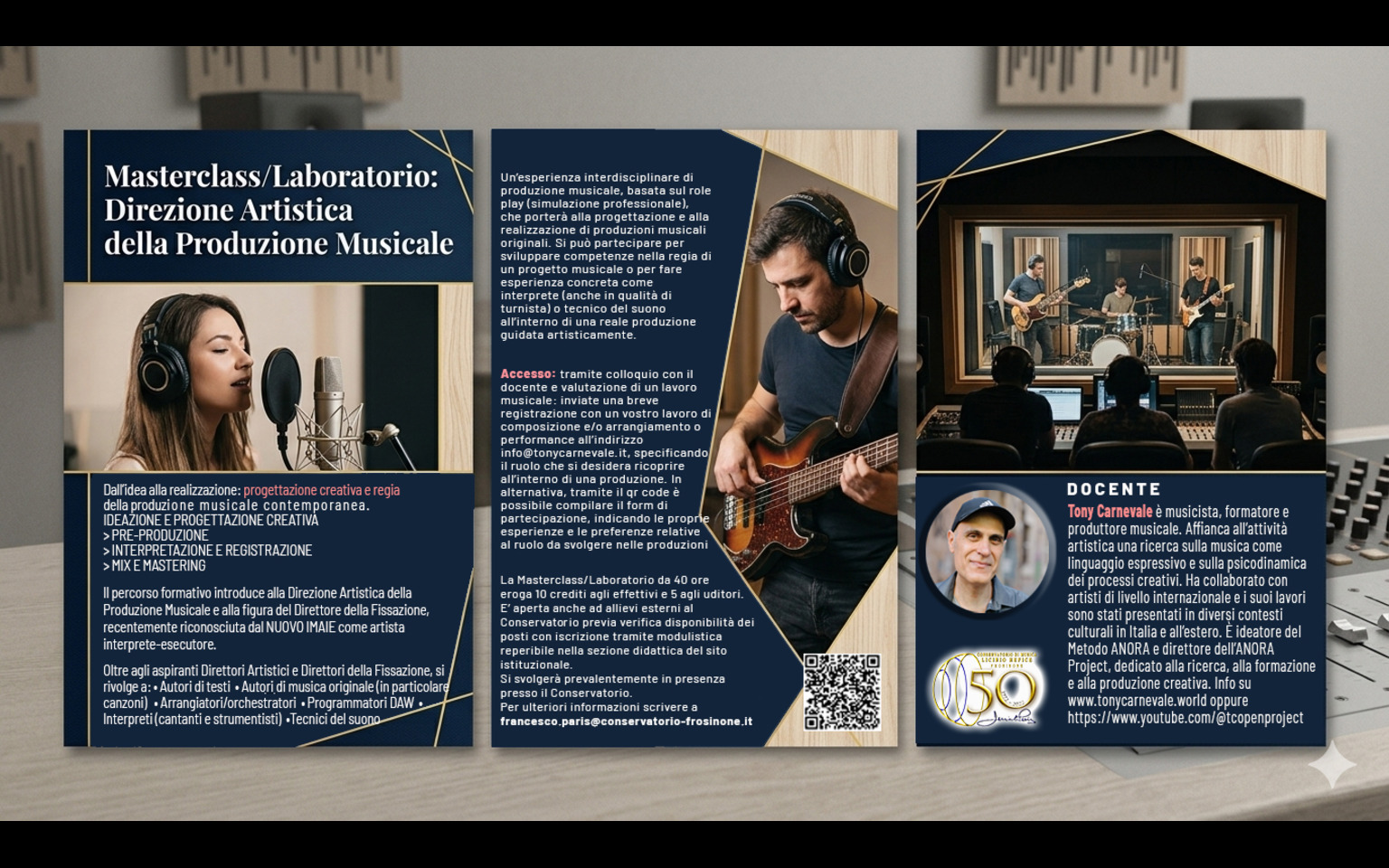
It is the new Laboratory/Masterclass, directed by Tony Carnevale, which will begin shortly at the Conservatory of Frosinone, with the recognition of 10 academic credits.
A new and original laboratory that does not start from music production itself, but from what makes it necessary: the birth of an artistic idea and the coherent development of a project identity.
This laboratory is also the first to explicitly and structurally address the development of the role of the “Fixation Director,” a professional figure now recognized within NUOVO IMAIE as a performer, with access to related rights.
The story of this new experience, in the words of Tony Carnevale:
“Sooner or later, it had to happen.
This is not an achievement, but the natural consequence of a path that began many years ago, in 2000, when I started the first laboratory within a Conservatory, focused on the creation and realization of original applied music. And that word, ‘original,’ was deeply connected to a long research that began in my adolescence and was first made public in 1986 through early writings on human reaction to sound and on the transformation of acoustic stimuli into inner psychic ‘images.’
That research continues today, after many articles, nine published books, and more than twenty-six years of formative practice focused on the development of creativity through musical language, documented in the TC Journal (online at anora.it).
After those early years within the Conservatory, I brought musical and artistic formative paths into other environments, less institutional and more open, often working in community contexts and informal settings, sometimes freely, always placing one thing at the center: the development of each person’s original artistic identity.
Throughout all these years, my work has not been about teaching music in the traditional sense, but about developing a deep research into creativity, into the psychodynamics of creative processes, and into music as an expressive and representational human language. A non-rational language, belonging exclusively to human experience, which can emerge only under specific relational conditions. A relationship between human creativities.
From this research, the ANORA Method was born. Not a method in the academic sense, but a space and time of work in which music is not explained, but lived. A process where a formative path becomes transformation, involving the relationship between the facilitator and the person within the formative path, and including the study of human reaction to sound also from a psychoacoustic perspective.
Over time, this work, carried forward through laboratories, has generated concrete, not theoretical results: it has supported artists, authors, and composers in developing complete and autonomous creative and production paths. Among them is the case of Stefania Graziani, who, starting as a pianist, developed her own artistic identity through this path, leading to the realization of an album (HANDS), born within the ANORA Project, in a process guided by her facilitator, who also participated as co-author.
This work has also opened an international dialogue, including exchanges with Berklee College of Music in Boston, through shared work with Professor Simone Scazzocchio, who directly took part in the laboratories, and through an editorial path that led to the publication of nine books, including the latest in English, currently being acquired by Berklee’s library, as well as a stable presence of these texts in conservatory libraries, cultural institutions, and public libraries.
Within this same path, not only artists and facilitators have emerged. Through the principle of integral composition, the realization of music, the work on sound, has never been considered a purely technical matter, but an integral part of the creative process. This is why it has also generated concrete professional paths, as in the case of a participant in the laboratories, Mattia, who now works in an iconic recording studio in Rome.
Perhaps this is one of the most significant aspects of this work: within the same formative space, different directions have emerged, all originating from the same process, the same research on creativity and artistic identity. The same approach to sound.
This path has not been linear. Over time, I have taken part in public selections within conservatories and institutions, encountering dynamics that many are familiar with, where merit is not always what determines the outcome.
And when this happens, it is not a personal issue, but a loss for those seeking a real path of growth.
At the same time, this work has been recognized and supported by institutions such as SIAE, which granted its patronage, IMAIE, INDIRE, and the Italian Ministry of Education.
Yet this formative work has grown largely outside institutional contexts, in an independent dimension, often invisible, always rooted in real work with people. For this reason, today this step carries a particular meaning.
The Laboratory of Artistic Direction of Music Production, now taking shape within the Conservatory, emerges directly from this path: a work focused not only on what is done, but on how creation happens, how an artistic idea is born, developed, and brought coherently to its realization.
This laboratory/masterclass within the Conservatory is therefore not a point of arrival, but the moment in which this path takes a new and more evolved form within an institutional context, while preserving its nature. It is not about bringing a “course” into a Conservatory, but about bringing an experience, a research, and a vision of music as a human language, as a space of creative relationship, listening, collaboration, and the construction of personal artistic identity within a collective context.
There is also a symbolic element: this new beginning takes place in the very same Conservatory where, in 2000, the first laboratories began. Some might call it coincidence. Today, that path reopens in a different way, with a deeper awareness built over time.
I would like to express my sincere thanks to Professor Francesco Paris, coordinator of the School of Electronic Music and Sound Engineering, who made this laboratory/masterclass possible within the activities of the Audiovisual Research and Processing Center.
We begin again with the same intention as before: not simply to understand how music is made, but to discover whether we truly have something to say, and how to find a way to uncover it, bring it out, and share it with others.
The Laboratory is also open to those who are not enrolled in the Conservatory, in continuity with the open dimension that has always characterized the ANORA Method. To those who have shared this path with me, even for a short time, I want to say something without sentimentality: all of this has been possible because there was real interest, because I could understand you deeply, because it was necessary to understand your difficulties in order to overcome them together. And everything that has been, today, is you and your artistic and personal lives.
This new laboratory is born in continuity with that path, but in a more evolved form, while preserving the principles and the necessary elaborations from which it originated.
All the information to participate is available in the poster attached to this post.
Let’s begin.”
For further information: info@tonycarnevale.it

