
Tony Carnevale’s ANORA Method at Berklee College of Music
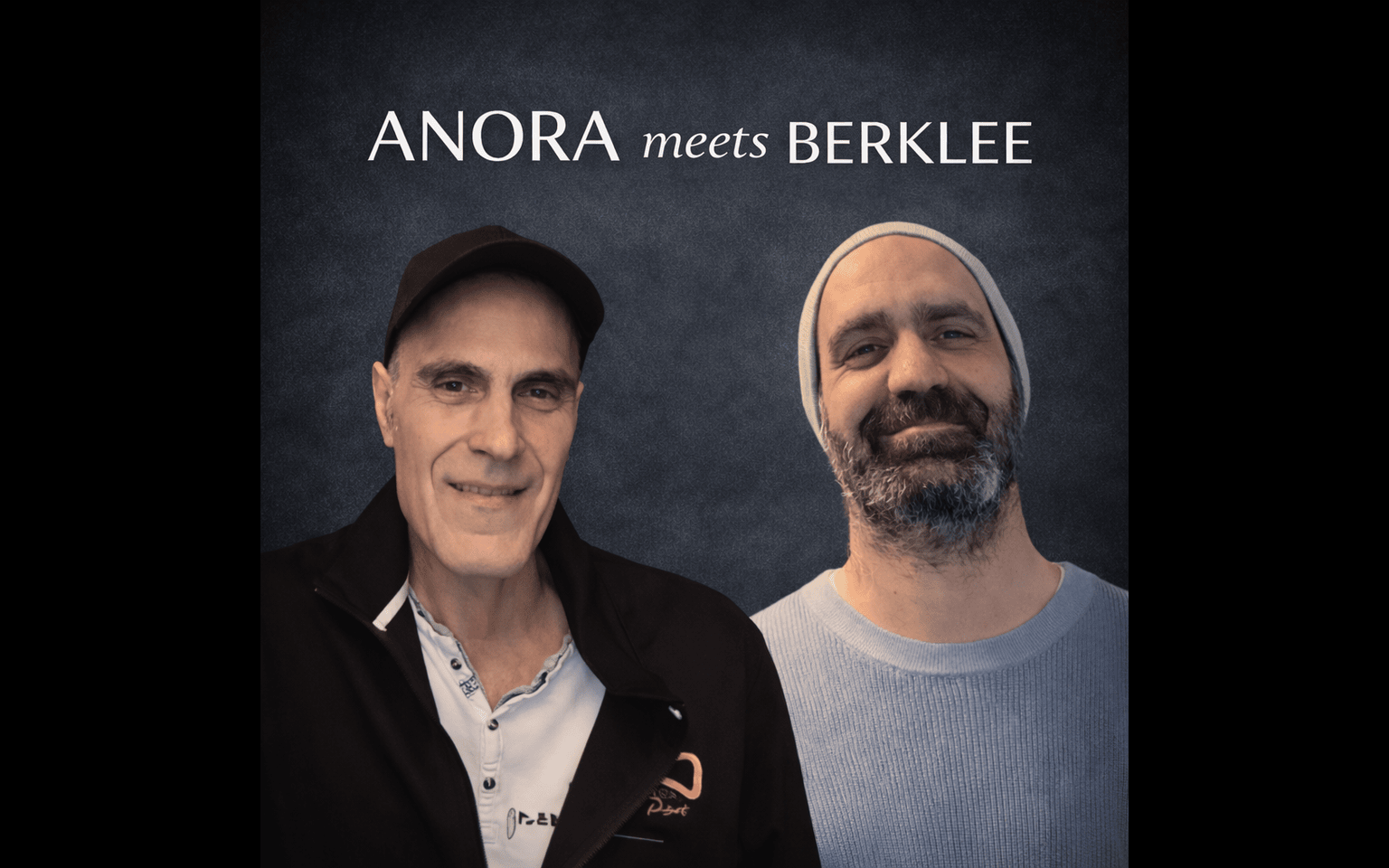
A particularly significant moment in Tony Carnevale’s path of research and musical development.
The ANORA Method is presented at Berklee College of Music in Boston through a video featuring a conversation between Tony Carnevale and Simone Scazzocchio, faculty member at the American institution. The link to the video can be found at the end of this article.
…there are moments that give meaning to what you have done.
Today is a special day. There had already been a prologue, something meaningful had already happened: my book Beyond Notes – Unlocking the Creative and Emotional Power through Music was in the process of being acquired by the Library of Berklee College of Music in Boston.
A recognition that connects a work born from years of research, formative practice, and reflection on musical experience as a human expressive and representational language, therefore non-rational, with one of the symbolic places of international musical development.
Before recounting this special event, which is important and deeply moving for me, it is necessary to take a step back and share some history.
The ANORA Labs, conceived and directed by me, were founded in 2000 at the Licinio Refice Conservatory in Frosinone, as the first laboratory in Italy dedicated to original applied music within an Italian conservatory. They were not conceived as a theoretical project, but as a concrete response to a real need: to create a space in which creativity, composition, sound, technology, and human and artistic experience could finally coexist within a single flow of musical development.
Over the years, the ANORA Labs have grown and expanded into various significant educational contexts and music institutions, receiving important institutional patronage and recognition, including from SIAE, with the support of NUOVO IMAIE, INDIRE, and the Italian Ministry of Education and Merit.
Within this now twenty-five-year-long experience, I have been able to develop an in-depth methodological research focused on the formative relationship, on the relational dynamics of learning, and on the psychodynamic aspects of creative and performative processes.
This research was not an external observation, but something lived directly through hands-on work with musicians in musical development.
After about ten years of formative practice in the field, this experience also began to take shape in more structured written reflection, reconnecting with research articles on human reaction to sound that I had already published in 1985 in a psychology research journal, and in 2003 in a psychiatry journal (Il sogno della farfalla). This led to the first book, followed by eight others, the most recent written in English for international dissemination.
Not to “theorize” a method, but to give a shareable form to something that already existed in practice.
It is no coincidence that what became the first book had originally been created as a handout for participants in the Labs.
This is how what is now known as the ANORA Method took shape: as the expression of a real experience, matured over time, rather than as an abstract system.
È all’interno di questa storia, e di questo percorso, che prende senso l’incontro che presento oggi e che per me rappresenta il raggiungimento di qualcosa di unico, e che diventa, contemporaneamente, un nuovo inizio: ANORA meets Berklee, a conversation between Tony Carnevale and Simone Scazzocchio.
This encounter arises from a relationship that goes back many years. Simone first encountered the ANORA Method by participating in the Labs as a musician in musical development, experiencing a path grounded in direct experience, shared and real creative work, and the formative relationship as the core of learning.
The ANORA Method was never conceived as something to be replicated.
It is an approach centered on the person, on their human reality, on their artistic and musical competences, on experience, and on the specific context in which that activity takes shape.
For this reason, it cannot be automatically “transferred.” Its principles can instead be internalized, transformed, and re-elaborated by those who have lived them, in relation to their own sensitivity, abilities, personal history, and working environment.
It is in this sense that the meeting with Simone takes on a particular value.
Over time, some of the principles that emerged during his path within the ANORA Labs were absorbed by him and fused with his personal journey, his musical style, and his way of teaching. Not as a model to be reproduced, but as a living stimulus, integrated into an autonomous practice coherent with his role.
Today Simone is a faculty member at Berklee College of Music in Boston, one of the most important musical development contexts internationally. For me, and for the ANORA Labs, this is a source of great pride and happiness.
The conversation presented in ANORA meets Berklee, beyond being a presentation of the method in a new formative context, is also an open dialogue between two paths that met over time and now find themselves on common ground: reflection on making music, on artistic identity, and on the challenges of contemporary musical development.
A central theme of the encounter is also the relationship with technology.
In an era characterized by unlimited access to software, tools, sounds, and resources, the risk of overload, decision paralysis, and loss of contact with the deeper meaning of the creative process becomes increasingly evident. The real challenge is not to accumulate possibilities, but to find sustainable practices and restore centrality to creativity and experience.
ANORA meets Berklee is therefore neither a celebration nor a conclusion.
Rather, it is the opening of a space for dialogue on what it means today to accompany a creative process, to develop artists, to develop people, while holding together competence, experience, relationship, and awareness.
There are no words to describe what I feel in the face of this collaboration. On the one hand, the Labs have evolved into a reality of artistic collaboration that has gone beyond the traditional mentor–person-in-development relationship (Artists for Artists), reaching a shared “making together.” On the other hand, with some participants, we have arrived at the possibility of collaboration on a formative level.
What more could one hope for?
If these are not true satisfactions…
You can watch the video here: https://youtu.be/ctIbBZJlk9c
The video is in English. On YouTube, automatic subtitles with translation into multiple languages can be activated.

