
Tu Che Mi Puoi Capire

– Asterisks of Music edited by Riccardo Storti (part one)
– Le Petit Monde Du Rock Progressive edited by Louis de Ny
– Asterisks of Music edited by Riccardo Storti (part two)
– Rotter’s Club by Giuseppe Di Spirito
– Left edited by Roberto Biasco
– NONSOLO PROGROCK by Massimo Salari

TRACK LIST
- Il suono della tua voce
This is a piece for piano and orchestra, featuring female voices.
It explores sound as “sense,” as the essence and substance of words, and of human expression itself.
Ideally, it refers to all voices, to all sounds: to the sense and resonances of the voices I have listened to throughout my life.
Voices that are also music: the “voices” of other composers, and even the recreation of those earliest moments of existence, when one perceives the mother’s voice while being nourished, without yet understanding words, but only pure sound.
It is dedicated to someone who has played an essential role in my life, someone who, through her voice, built a deep and living relationship with me and with others.
That voice still resonates within me, not only as a physical sound, but as “receptivity,” sensitivity, memory, and profound inner significance, as an “inner image of the feminine.”
Part of my concept of “integral composition,” this piece — like the entire album — was entirely written, arranged, orchestrated, performed, mixed, and mastered by me.
2. Quel discorso che non abbiamo mai finito
It is a piece for piano and a few other instruments, in which the strings emerge like memories rising back to the surface, only to sink once again into the depths of memory. It is dedicated to a person with whom I, along with many others, shared a profound search; a relationship interrupted by their passing.
The title is meant to express exactly this: that talk we never finished, a talk made of constant variations and adjustments, a restless search whose ultimate purpose was, perhaps, the search itself. Several years after that painful separation, I feel that relationship, that “talk,” that search continuing silently within me. Music becomes the space where that ongoing process of seeking, changing a little each time, improving week after week, brings that unfinished exchange back to life through sound; thematic ideas in constant dynamic variation, a “talk” that no longer has the sound of words, but of memories manifesting through musical instruments.
Transforming absence into inner resonance, loss into memory and movement. Like the entire album, the piece moves through Modern Symphony, pianistic writing, and my expressive-representational approach to composition.
3. Ad ogni incontro
This piece aims to represent moments from a collective story.
For years, different people gathered to experience together a path of care, training, and research, arriving in one way…and leaving, each time, changed by the human relationship with the person who guided that experience. An approach in crescendo, gradually more and more “charged,” until the encounter with a transformative energy that re-harmonizes everything. The piece aims to express exactly this: the energy of a profound encounter, its inner rhythm, its ability to bring out parts of ourselves that we often had not yet known. The negative dimensions that are transformed in the relationship with another human being, capable of understanding the unconscious. Through orchestral contrasts, movements, and suspensions, the music tries to represent that silent transformation that each encounter carried with it. A change that cannot be explained with words.
It is recognized. It is carried within. It is also a personal dedication to someone who deeply marked my life, reminding me that every encounter is a passage and an opportunity for inner growth. The piece is part of my idea of Integral Composition: everything was written, arranged, orchestrated, performed, mixed, and mastered by me.
4. Oltre le note
It is a work for solo piano, conceived as an experimental study on movement and emergence.
The initial idea was to explore whether, by allowing the hands to move in a continuous and organic flow, thematic elements could arise almost spontaneously — not directly from written composition, but from the pianistic gesture and movement itself.
The piece is divided into three movements — Adagio, Allegro, Grave — following a tripartite form in which each section represents a transformation of motion and resonance.
The first movement explores the middle-low register, dense and introspective; the second unfolds with faster, rhythmically structured energy; the third ascends toward the higher register, becoming almost dreamlike: suspended and luminous.
The title, Beyond the Notes, reflects not only the idea of going beyond what is written, but also beyond what can be perceived “visually” — that dimension which emerges only through listening, where sound becomes something more than its own material reality.
5. Pagine dal libro dei sogni
When music is born as an inner narrative, as deep memory, it reveals itself in the moment when imagination takes shape in sound and encourages the creation of “images” in the listener.
Pages from the Book of Dreams is meant to be precisely this: a large-scale symphonic piece for piano, orchestra, and solo instruments — including cello, oboe, and others — inspired by a unique experience, that of Collective Analysis.
The piece should be turned through like an album of “inner images,” non-visual memories: each page reveals a new dream, a new voice, a new sound. A movement of thoughts, emotions, and different identities shared with the many people present.
Each section of the piece, in fact, symbolically corresponds to a dream told by a different person in the group. With each new dream, the music changes — new colors, new timbres, new movements — creating a continuous flow of images and transformations, which is nevertheless brought back within a harmonic and linear movement.
At a certain point, however, this flow is abruptly interrupted: a dramatic event, the end of a fundamental relationship, the disappearance.
Only the piano remains, silently recalling one of the initial themes, like a memory resurfacing and being processed in solitude.
Little by little, it “understands” that “the story” is over, and slowly withdraws, detaching itself from that story.
What remains is pain, expressed in a melancholic moment that closes the piece and stays as an indelible experience. This work therefore aims to be a representation of sound as an invisible inner image of the human being: not simply notes, but the audible form of deep memory, revealed through the act of sharing dreams.
6. La vita che grida – Symphonic version
It is one of the most significant works in my artistic journey.
It is not a cry of pain, but a hymn to life: to its energy, its regenerative force, and its creative power. Originally released in 1995 on the album of the same name, the piece has, over time, become a kind of personal poetic and expressive manifesto, capable of crossing generations and genres without losing its communicative strength. This Symphonic Version takes up the original recordings and enriches them with orchestral writing that expands their emotional space, while preserving the intimate and human essence of the composition and its lyrics.The piece features the extraordinary participation of Francesco Di Giacomo and Rodolfo Maltese of Banco del Mutuo Soccorso: two central figures in my artistic life, two true friends, two “myths” of Italian progressive music, whose presence gives the piece a profound human and emotional depth. The Screaming Life is directly connected to the following piece, …To the Time Wonderfully Lost Together:together, they form a small suite in two movements, conceived as a single expressive work in continuity. The original version was included in the encyclopedia L’Italia del Rock (La Repubblica), a historic collection dedicated to Italian progressive music and rock.
From the original booklet of the first version:
“Il grido del bambino.
L’orgasmo.
Il nuovo pensiero.
Portala con te questa vita che grida.”
“Forse non esistono parole adatte per descrivere il significato di questo brano: incarna la vita stessa in tutte le sue forme infinite, la sua forza e la sua fragilità, gli assalti continui che la stupidità e la violenza infliggono all’immaginazione ogni giorno, e la risposta emotiva di chi non si arrende, di chi continua a credere nella bellezza e nella trasformazione.”
La Vita che Grida (text)
Sbatte nei perché questa vita che grida
e un colpo è una ferita,
spalle contro al muro guarda dritto a te,
non perdere la sfida.
Quanto durerà quella linea infinita
che ti confonde il volo?
Segui quella scia di un airone che migra,
che cerca quello che non ha,
la terra che non ha.
Racconterà di sé
a un cielo che già sa
che un altro giorno verrà.
Portala con te questa vita che grida,
che cerca un’altra riva,
che non cede mai a una notte sbagliata
ma ha il sole tra le dita.
Sole che verrà a incendiarti la vita
con tutto il suo calore,
donna che sarà una vita che grida
e come un’onda crescerà,
e mare si farà,
e parlerà di te,
of a man who already knows
che un altro giorno verrà,
in questa vita che grida, che grida, che grida.
Portala con te, questa vita che grida.
7. …al tempo meravigliosamente perso insieme
A closing piano improvisation — intimate, reflective, and full of memory. It looks back on a beautiful human and artistic bond, connected to La Vita che Grida and to my friends Francesco Di Giacomo and Rodolfo Maltese of Banco del Mutuo Soccorso. La Vita che Grida (Symphonic Version), this piece forms a kind of small suite: two connected movements that mirror each other in emotion and perspective, one symphonic and collective, the other solitary.The piece recalls a moment from my youth, when at fourteen I discovered their music — especially the song Non Mi Rompete, written by Francesco — while experiencing my first love. Non Mi Rompete, written by Francesco — whilst I was experiencing my first love. That music and that emotion became one, forming a single memory that has never left me. Towards the end, the piano spontaneously alludes to the theme from Non Mi Rompete, as if it were emerging naturally from the improvisation itself: a brief appearance that feels like an encounter across time, between memory and creation. This final track is both a memory and a dialogue with the past: a calm epilogue that brings together the personal, musical and human significance of La Vita che Grida.
THE PROJECT
TU CHE MI PUOI CAPIRE
In the Author’s Own Words: This is a distinctive album whose underlying expressive movement is connected with separations: those arising from “dissonant” relationships, those connected with events in the natural course of life, and the memories that consequently settle deep within us in the wake of those separations. It is an album with many dedications, written on the back cover: some to people who are no longer with us, others to people from whom we have parted but of whom we retain an emotional and indelible memory.
It is therefore also a work of re-creating those memories; hence the choice of vinyl, precisely in order to re-create those magical moments when, as teenagers in the 1970s, we would stand in line outside record stores because a new record had come out. We might buy just one copy and then rush to the home of whoever had the best “stereo,” so that we could listen to it together.
(Tony Carnevale)
This experience of “listening together” has been a foundational aspect for the author, inspiring him to develop one of the core principles of the Laboratori di Musica Originale—an initiative that has earned the prestigious patronage of SIAE and the support of IMAIE. He has been directing this program for the past twenty-three years. This concept also aligns with a music philosophy centered on deep listening, especially in a time when the visual tends to dominate, with performance often taking precedence over the true essence of sound. Too frequently, audiences attend concerts to “watch” rather than to “listen” in the most profound sense of the term. This experience of “listening together” has been a foundational aspect for the author, inspiring him to develop one of the core principles of the Laboratori di Musica Originale—an initiative that has earned the prestigious patronage of SIAE and the support of IMAIE. He has been directing this program for the past twenty-three years. This concept also aligns with a music philosophy centered on deep listening, especially in a time when the visual tends to dominate, with performance often taking precedence over the true essence of sound. Too frequently, audiences attend concerts to “watch” rather than to “listen” in the most profound sense of the term.
Perhaps now is precisely the time to propose a return to listening together, to sharing a collective experience of emotional responses, to an ‘immediate’ exchange of feelings and emotional experiences.
(Tony Carnevale)
Perhaps having the author tell us the meaning of the work, his personal and emotional experience, the memories, the anecdotes, and the truth about the sounds he chose to establish an emotional relationship with other human beings.
“Sentire” together.
‘But it is also a work that relates to movement, a return to the experiences I had when I was writing for human movement, for dance. It is no coincidence that the cover features a dancer on a piano, a female image that can create visible movements with her body, creatively relating to the invisible movements of sounds. Tu Che Mi puoi Capire, is a phrase with many possible interpretations: you, as a ‘human being’, have the possibility of understanding; but it is also a possible dedication to those who are able to understand what sounds express, or only to those who are able to ‘understand’ these ‘sounds’, chosen for this work. Or, again, you who can understand the work behind these forms of expression, the enthusiasm and effort, the joy and dissatisfaction that comes from always wanting to do better. And last but not least, you who can understand because you simply allow yourself to listen, without gender bias, without ‘expecting’ something predetermined.’
(Tony Carnevale)
From a more musical perspective, this is a unique project entirely created by the author, released on vinyl with a complimentary CD included in the packaging to accommodate all listening preferences. Along with several orchestral compositions, it features a small piano sonata and a tribute to Francesco Di Giacomo and Rodolfo Maltese of Banco: a symphonic arrangement of the well-known song La vita che grida, originally from their 1995 album, reimagined as a mini-suite for solo cello, piano, orchestra, and band. Like other works by the author, this album blends various musical languages and enjoys a sense of formal freedom. It is subtitled Immagini per Pianoforte e Orchestra (Images for Piano and Orchestra), reflecting the concept of sound as an “internal image” of the human experience. This theme ties directly to the extensive research the author has pursued over the years, published in several books, including his latest, Oltre le note (Beyond the Notes)—a title that also appears as one of the tracks on this new album
“The subtitle is linked to a whole personal research project that aims to present music as a “psychic experience” and “sound” as a psychic image: when we dream and images are formed from our unconscious, we “hear” sounds without physical perception. This means that, on a mental level, “sound” is an image. And then there is “resonance”, the creative reaction of the listener, who creates a new “image” within themselves, a psychic experience, stimulated by sounds, by another human creativity.
Tu Che Mi Puoi Capire, …ascolta.”
(Tony Carnevale)
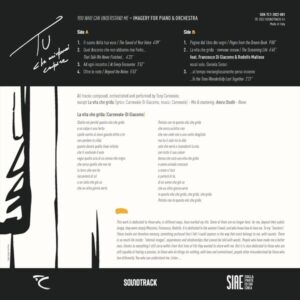
| Tracklist vinyl version | |
| Side A: | |
| 1. Il suono della tua voce | (4:09 – ITDH22200017) |
| 2. Quel discorso che non abbiamo mai finito | (4:23 – ITDH22200018) |
| 3. Ad ogni incontro | (3:52 – ITDH22200019) |
| 4. Oltre le note | (5:53 – ITDH22200020) |
| Side B: | |
| 1.. Pagine dal libro dei sogni | (9:00 – ITDH22200021) |
| 2 .. La vita che grida – Symphonic version | (6:45 – ITDH22200022) |
| 3. . …al tempo meravigliosamente perso insieme | (2:21 – ITDH22200023) |
| Durata totale | :36:23 |
| Tracklist CD version | |
| 1. Il suono della tua voce | (4:09 – ITDH22200017) |
| 2. Quel discorso che non abbiamo mai finito | (4:23 – ITDH22200018) |
| 3. Ad ogni incontro | (3:52 – ITDH22200019) |
| 4. Oltre le note – 1st Movement | (5:53 – ITDH22200020) |
| 5. Oltre le note – 2nd Movement | (5:53 – ITDH22200020) |
| 6. Oltre le note – 3dh Movement | (5:53 – ITDH22200020) |
| 7. Pagine dal libro dei sogni | (9:00 – ITDH22200021) |
| 8. La vita che grida – Symphonic version | (6:45 – ITDH22200022) |
| 9. …al tempo meravigliosamente perso insieme | (2:21 – ITDH22200023) |
| Durata totale: | 36:23 |

