
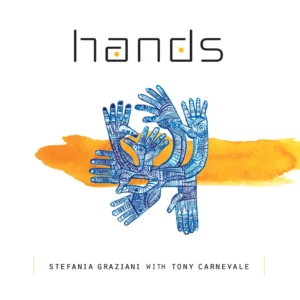
Hands
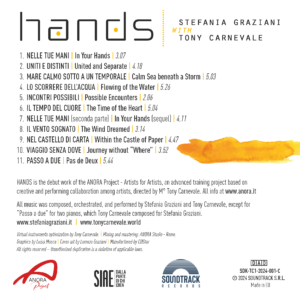
TRACK LIST
- Nelle Tue Mani:
This piece is centered on a thematic cell in the piano, around which the orchestra moves with a driving rhythmic momentum, while expansive themes interact with one another.
As the opening track on the CD, its title also expresses the meaning of the collaborative relationship: placing oneself in another person’s hands, entrusting oneself to them and trusting them. It conveys the meaning of a relationship that is unlikely to disappoint because it unfolds within a context of clear guidance and artistic direction.
2. Uniti E Distinti:
The piano supports a dialogue between two violins, while the sound of a human voice in the background evokes distant memories.
Here too, the title is connected with the meaning of the concept: United and Distinct, like the two artists themselves, each distinct from the other in musical style and identity, yet both united by the same way of experiencing music and artistic expression, without which a project of this kind could not have been created.
3. Mare Calmo Sotto A Un Temporale
A thunderclap breaks the silence, and beneath persistent rain the piano moves through shadowed tones, underscored by timpani and by rhythmic phrases from flute and cello.
Gradually, the atmosphere opens into a dynamic crescendo as other instruments enter, almost as if to express a return to “clear skies.”
The “calm sea” is an inner image, always exposed to the “storms” of interpersonal relationships.
4. Lo Scorrere Dell’Acqua
A repeated sound, like a drop falling with the same force and at the same pace, combines with the sounds of human voices to create an almost dreamlike atmosphere.
Once again, the piano is the root from which an interweaving of thematic phrases for violin, cello, oboe, flute, and duduk branches out, in a continuous dialogue among the instruments.
5. Incontri Possibili
This piece marks a break in the flow at the midpoint of the album. The sound of the harpsichord surprises the listener and carries them back in time.
Incontri Possibili is a “tribute” to the style of Johann Sebastian Bach and to the legendary Ian Anderson.
The piece also carries another possible interpretation: the intention to move beyond musical genres and free music from definitions and rigid categories. Artistic expression is, and must remain, free of all rigidity of thought, so that certain encounters may indeed become possible.
6. Il Tempo Del Cuore
The heartbeat sets the pulse of this piece, whose intimate and calm atmosphere is carried by the sound of a harp.
The piano first appears in the background, then emerges into the foreground in the central section of the piece, where it completely envelops the sound of the harp.
The time of the heart, the capacity to love: this alone matters and gives meaning to life.
7. Nelle Tue Mani (reprise)
This piece is a reprise of the opening track. The same thematic cell in the piano now evolves, modulates, and grows rhythmically more intense in a crescendo, as violin, cello, and winds sing out a new theme.
The piece serves as a bridge to the second half of the album.
8. Il Vento Sognato
An empty, silent concert hall. A light wind enters through a half-open window and, as it blows, begins to animate the wind instruments: a timid flute starts to move, pursued by its own fear.
Then it gathers courage, but just as it begins to assert itself, a “ramshackle” orchestra lurches into motion, giving life to a clumsy symphony.
This almost drunken movement, which a snare drum tries to straighten out, culminates in an intense crescendo and an accelerando that gradually comes apart until it collapses.
After orchestrating a magical, imperfect piece of music, the wind leaves. And the dream with it.
9. Nel Castello Di Carta
The sound of a celesta evokes dreamlike atmospheres. The sound of the wind, carried over from the previous piece, leads into an otherworldly landscape… a paper castle that comes alive at night with love stories among characters born of dreamlike imagination.
At a certain point, the piano breaks the spell. Growing ever more insistent, it races upward until it reaches the highest register of the keyboard, then cascades down toward its deepest register.
Calm returns. The sound of the celesta returns, carried away by the voice of the wind until it fades.
10. Viaggio Senza Dove
The sound of the piano marks a break from the almost playful atmosphere that precedes it: the musical landscape becomes intimate and calm.
A cello enters over the piano line, answering it and shaping phrases until a pause. The second part of the piece begins immediately with a tighter, more urgent drive: piano and cello intensify their movement, while ethnic percussion heightens the tension.
In the finale, a choir enters unexpectedly in an intensely powerful emotional crescendo.
11. Passo A Due
This is Tony Carnevale’s tribute to Stefania Graziani, a piece for two pianos that seeks to tell the particular story that connects them, as well as its possible future.
There is a first phase in which he stimulates her creative process, followed by a second phase in which she is invited to take the initiative and he follows, supporting her.
This then leads toward a possible “making together”: the two piano parts intertwine and, in an ideal future, the roles evolve into a more mature and conscious dialogue. This relationship is necessary if they are eventually to reach a separation: the moment when she will be able to continue her artistic path on her own.
THE PROJECT
HANDS
The key idea of this work centers on the word “collaboration,” which is not merely a form of “working together” in artistic and practical terms (composition and performance), but also a collaboration grounded in a shared vision, in an ideal: a shared way of living and understanding music and artistic expression. The contents of these ideals are further articulated in the eight books written by Tony Carnevale and are supported by the ANORA Association. The ninth book, Beyond Notes – Unlocking the Creative and Emotional Power through Music, written in English, is currently in the process of acquisition by the Library of Berklee College of Music in Boston.
Stefania Graziani’s previous album, La Musica Cambia, had already been created and developed under the artistic direction and with the creative involvement of Tony Carnevale, within the formative context of the ANORA Laboratories (ANORA Labs), conceived and directed by him, and grounded in a distinctive vision of music and artistic training shaped over many years devoted to research and the education of other artists.
Hands also tells of the compositional collaboration and artistic relationship between a man and a woman, which led to the creation of a work in which both, united and distinct, recognise themselves.
To signify that it is possible to overcome the many sad stories of women whose creativity was dulled or crushed by negative relationships with the men who were close to them.
Finally, the title of the album, Hands, carries many possible meanings: hands, like the hands we use to “make”; hands that follow the movement of thought in order to “bring artistic forms into being”; hands that therefore express a fusion of mind and body, rejecting an abstract kind of making or one entrusted to artificial intelligence.
But hands, fundamental instruments for human beings, can also do much more.
Hands reaffirms the need to value, and perhaps even defend, an “artistic making” that must necessarily pass through musical craftsmanship: knowing how to make things, not merely to think them, but to know how to bring them into concrete existence with one’s own hands.
Hands that “know,” because their knowledge has been formed through experience, through doing in order to learn how to do, in a world in which “saying” seems increasingly, and dangerously, to prevail as a way of pretending to know how to “do.”
Hands that have also “sweated”: both artists have classical backgrounds, having studied at a conservatory.
Perhaps this too contributed to the development of a certain kind of musical thought, certainly built on a passion for expression through sound, but also forged by the need to develop a method of study and work in order to achieve the desired results.
With regard to the production process, after an initial shared creative phase, the work passed into Tony Carnevale’s hands for the further artistic development of the compositions and for the entire technical production, from the optimization of the virtual instruments to mixing and mastering.
From a performance standpoint, the work was created by playing the sampled instruments one by one.
It is a poetic approach that Carnevale has fully realized in his first album, Risonanze, in the recent Tu Che Mi Puoi Capire, and in other works, and has also described in detail in his book Oltre le note – A Non-Rational Approach to Music, where he defines it as Integral Composition.
It is therefore a compositional process that begins with the image-idea and ends with the final master, grounded in the conviction that the shaping of sound itself—as electronic composition, after all, teaches us—is part of the creative process.
From a conceptual standpoint, it could be defined as Virtual Multi-Instrumentalism, or Electronic Multi-Instrumentalism, with reference to acoustic multi-instrumentalism, as exemplified by Mike Oldfield’s celebrated Tubular Bells.
Artistically speaking, in a broader sense, it proposes a compositional process similar to the modeling of malleable materials, such as clay, in which form takes shape progressively and at the same time as the composition itself.
In this sense, it is close to improvisation intended for later development, ultimately producing a complete, immaterial work.
CREDITS
| Composed and executed by | :Stefania Graziani, Tony Carnevale, except Passo A Due composed by Tony Carnevale |
| Keyboards and Samplers | Tony Carnevale, Stefania Graziani |
| Virtual Instruments | OptimizationTony Carnevale |
| Artistic Direction and Final Sound Direction | : Tony Carnevale |
| Phonographic producer: | SOUNDTRACK S.R.L. |
| Recorded to: | ANORA Studio |
| Mixed and Mastered by: | Tony Carnevale |
| Record Labe | l :SOUNDTRACK Records |
| Musical Editions | :SOUNDTRACK S.R.L. |
| The cover design by | :Lorenzo Graziani |
| Project grafico | :Luisa Mosca |
| Video promo e Teaser | :Donovan Pontoriero |
| Printed by | :Cd Star Srl |

